




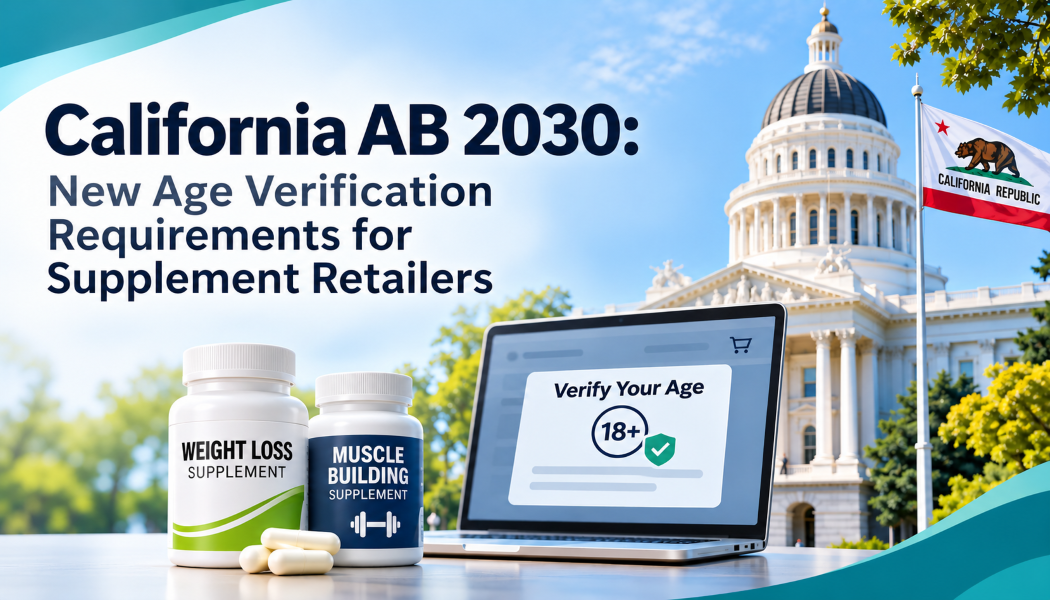
California is introducing new age verification requirements for retailers selling certain dietary supplements, and businesses have limited time to prepare.
On September 28, 2026, California Governor Gavin Newsom signed Assembly Bill 2030 (AB 2030) into law. Beginning January 1, 2027, the legislation will prohibit the sale of certain over-the-counter diet pills and dietary supplements marketed for weight loss or muscle building to individuals under the age of 18.
For ecommerce businesses, supplement retailers, and online marketplaces, this means reviewing product classifications, updating checkout procedures, and implementing age verification measures that meet the new requirements.
As the effective date approaches, businesses selling affected products to California consumers should understand how AB 2030 may impact their operations.
Assembly Bill 2030 is a California law establishing age restrictions on the sale of certain over-the-counter diet pills and dietary supplements marketed for weight loss or muscle building.
The legislation is intended to limit minors' access to products within these categories by requiring retailers to take steps to verify purchasers' ages.
Under AB 2030:
The new restrictions take effect January 1, 2027, making advance preparation important for businesses operating in the dietary supplement industry.
AB 2030 applies to certain over-the-counter diet pills and dietary supplements labeled, marketed, or otherwise represented for weight loss or muscle building.
Products potentially affected include supplements promoted for:
Importantly, the law does not provide a definitive list of prohibited products or ingredients.
Factors such as product labeling, advertising claims, ingredients, website categories, and how retailers present products may influence whether a supplement falls within the law's scope.
This means businesses should review not only their product inventory but also how those products are marketed and categorized online.
For ecommerce businesses, one of the most significant aspects of AB 2030 is its age verification requirement.
Online and delivery sellers of covered products must use one of two approaches:
The seller must obtain the purchaser's full name, date of birth, and residential address and verify the information against one or more qualifying third-party databases regularly used for age and identity verification.
The seller may instead use a delivery method requiring an adult age 18 or older to sign for the shipment and present valid government-issued photo identification.
These requirements make age verification an important part of the online purchasing process for businesses selling affected products.
Simply adding an "I am 18 or older" checkbox to a website does not satisfy the law's specified verification methods.
With AB 2030 approaching, businesses should begin evaluating their current checkout and verification procedures.
Waiting until the law takes effect could leave retailers scrambling to update their systems, train employees, and address potential compliance gaps.
Businesses should consider taking the following steps:
Identify dietary supplements and over-the-counter products that may fall within the law's definitions.
Determine whether current checkout processes meet the new requirements for covered online sales.
Ensure age verification can be incorporated into the purchasing process without creating unnecessary complications for customers.
Employees should understand why age verification may be required and how to assist customers experiencing verification difficulties.
Work with legal or compliance professionals to confirm that age verification practices and product classifications align with California's requirements.
Preparing early gives businesses more time to implement changes and maintain a consistent customer experience.
As age verification requirements expand across different product categories, ecommerce businesses need reliable ways to confirm that customers meet applicable minimum age requirements.
AgeChecker.Net provides age verification solutions designed for online businesses selling age-restricted products.
With age verification integrated into the ecommerce checkout process, businesses can verify customer information and request additional verification when necessary.
For supplement retailers preparing for AB 2030, AgeChecker.Net offers capabilities such as:
Businesses should confirm that their specific configuration and verification methods satisfy the requirements applicable to their products and sales channels.
Learn more about AgeChecker.Net's age verification solutions.
California's AB 2030 is part of a broader trend of states introducing age restrictions for additional consumer product categories.
Age verification requirements are no longer limited to traditional age-restricted industries such as alcohol, tobacco, and vaping products.
Certain dietary supplements are now receiving additional regulatory attention, making it increasingly important for online businesses to monitor legislation affecting their products.
For retailers operating across multiple states, maintaining adaptable age verification processes can help accommodate different legal requirements as they evolve.
The January 1, 2027 effective date is approaching.
Businesses selling weight-loss or muscle-building supplements to California customers should use the remaining time to review their products, evaluate checkout procedures, and determine whether additional age verification measures are necessary.
Implementing an appropriate verification process before the deadline can help businesses reduce compliance risks while maintaining a straightforward purchasing experience for adult customers.
AgeChecker.Net helps ecommerce businesses manage age verification requirements with solutions built for online checkout.
Visit AgeChecker.Net to learn more about age verification for your business.
Disclaimer: This article is provided for general informational purposes and does not constitute legal advice. Businesses should review the official legislation and consult qualified legal counsel regarding their specific compliance obligations.
